




Showing posts 86 - 90 of 225 matching: justice league international
Wednesday, September 1, 2021
Two Americans in Paris
This time next week, we should have a copy of Blue and Gold #2 in our hands. (Fingers crossed!) In the meantime, let's take a look back at the earliest adventure of Blue and Gold.
Any wiki site can tell you that the very first time Blue Beetle and Booster Gold both appeared in the same panel (much less in the pages of the same book) was 1987's Justice League #3.
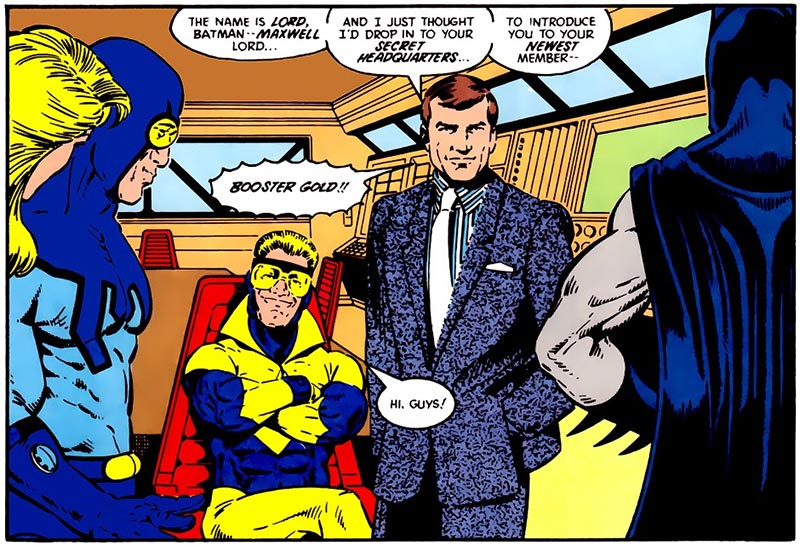
But despite working together as a team for the first time in the following issue, the pair wouldn't really become a pair for a few months more, not until they paid a visit to Paris in Justice League International #8, by Keith Giffen, J.M. DeMatteis, Kevin Maguire, et al.
(Don't let the "International" in the name fool you. This was a continuation of the same series. "International" was added to the title starting in issue 7, and would remain there until issue 26, when the book returned to it's "America" roots for the duration of its 113 issue run.)
If you're keeping track, this was Booster's second visit to Paris that year. He had already been with Black Canary in the pages of Justice League Annual #1 (as we saw here). Booster didn't have a lot of luck romancing Canary, and his bad luck with women would continue into the International era.
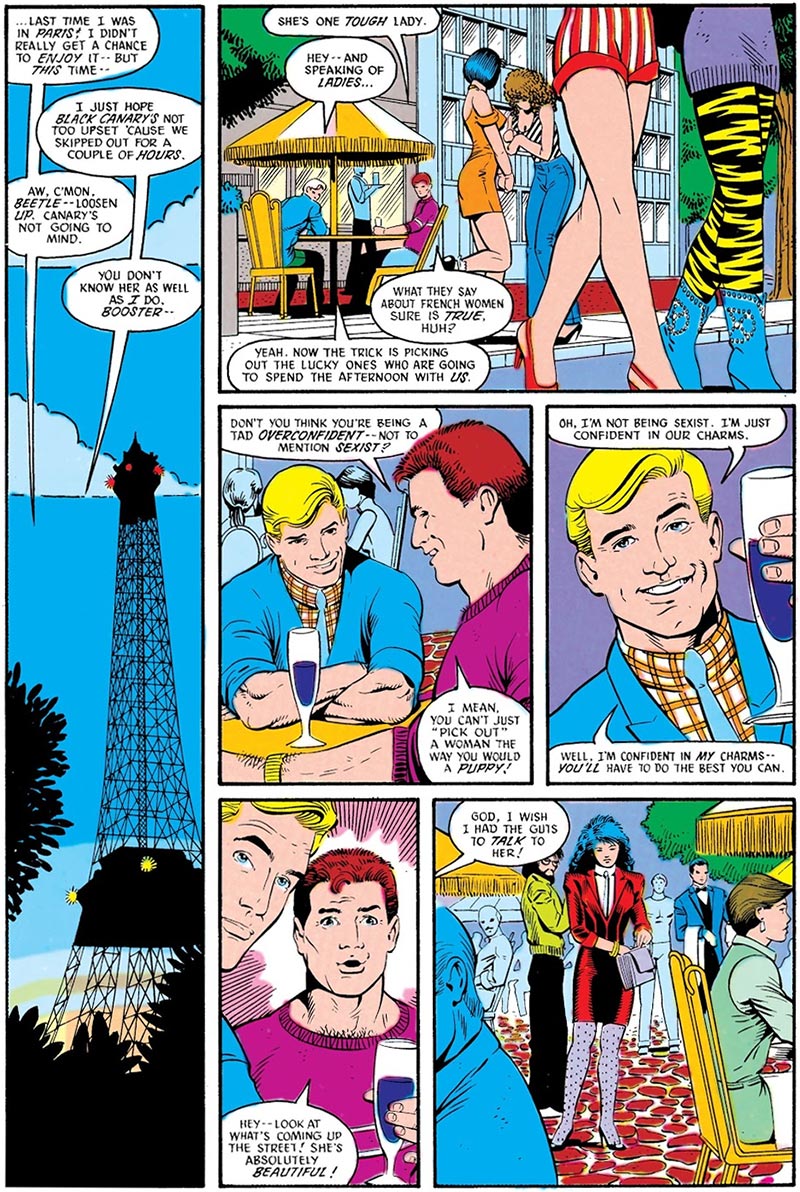
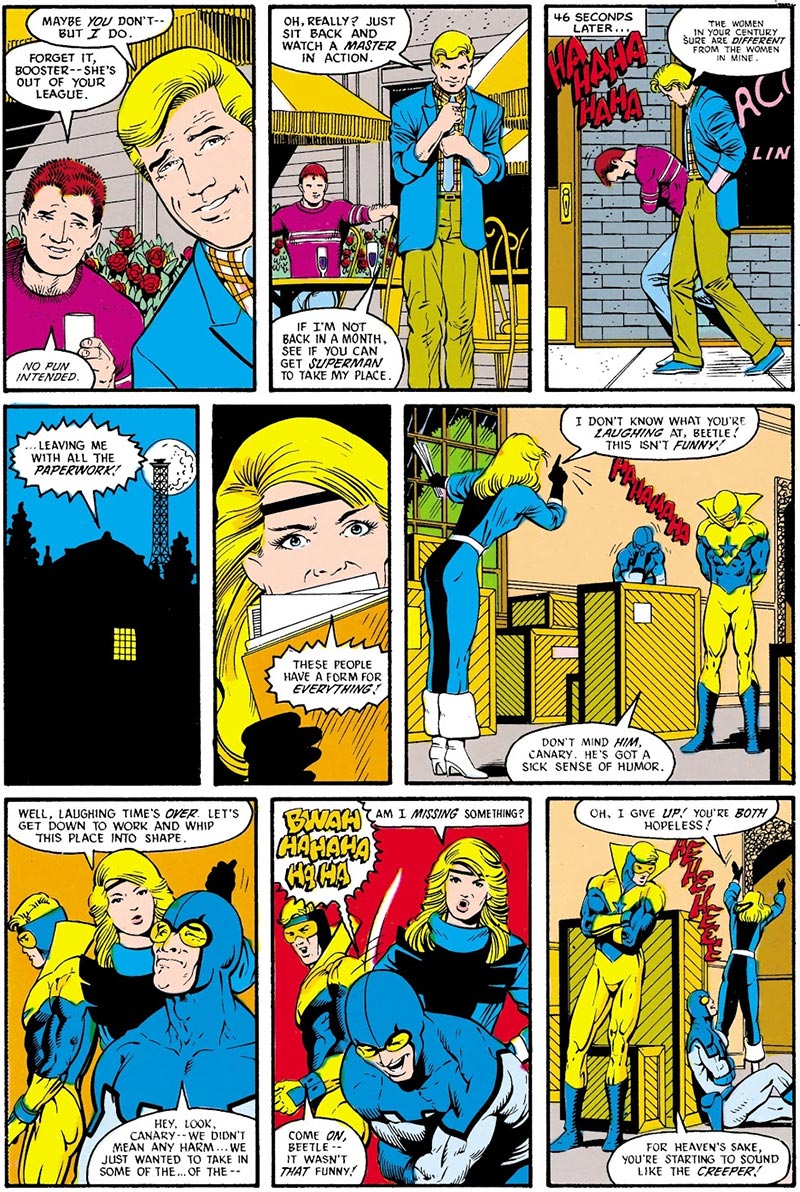
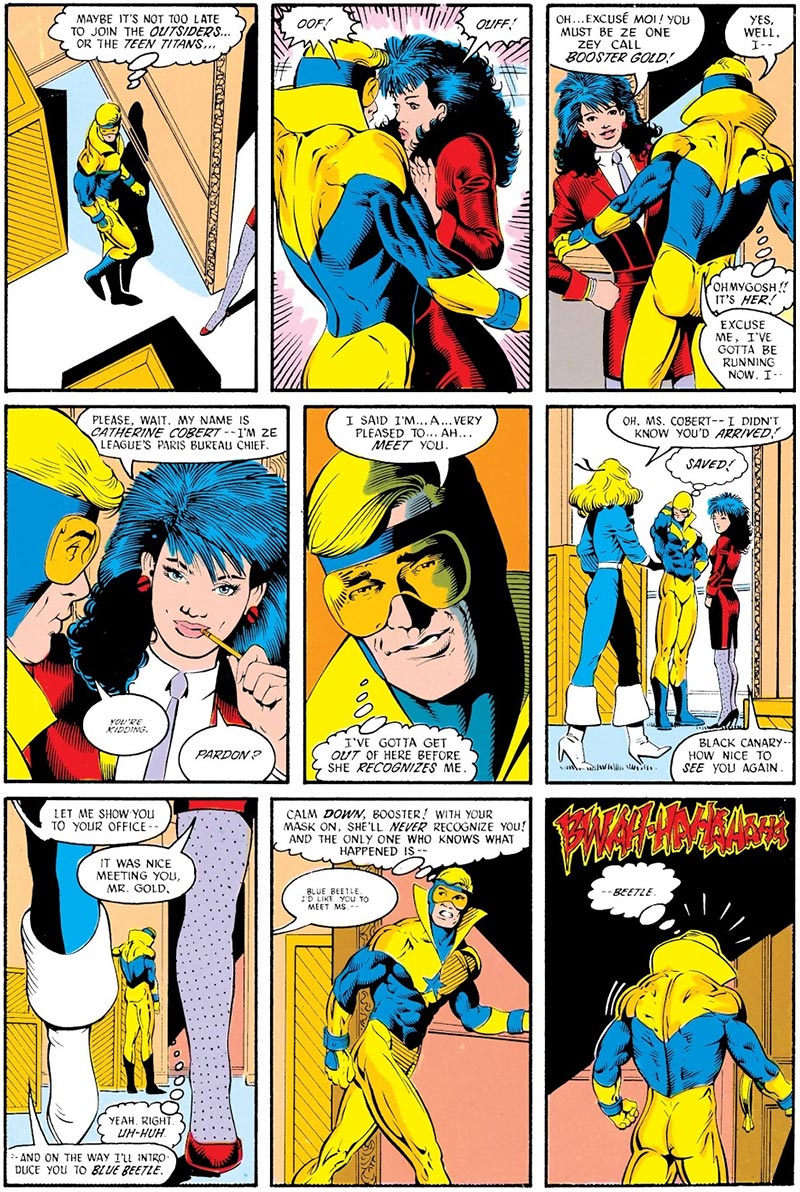
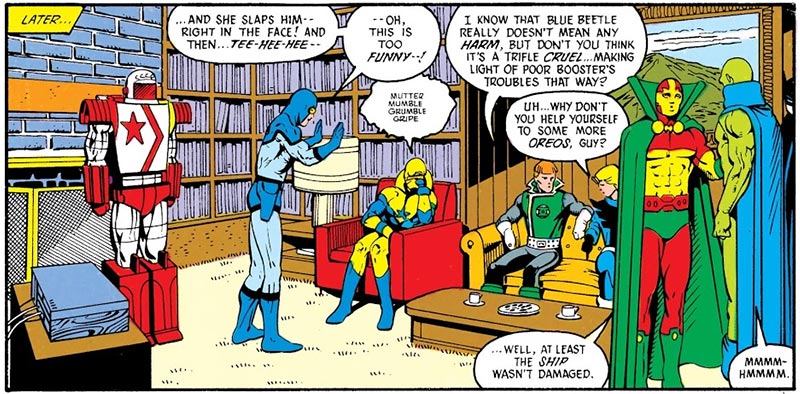
Thus the template was set for Blue and Gold's enduring (and endearing) 34-year-and-counting comedic bromance. Perfect from the beginning!
If you want to impress your friends, take note of the "Bwah-ha-ha" Beetle unleashes in Black Canary's presence (page 14 of the original story). That's the first appearance of what would become the pair's signature laugh!
And that's how comic book legends are made: one panel at a time.
Comments (5) | Add a Comment | Tags: blue and gold justice league international

Monday, July 12, 2021
Marketing 101
On Friday, comic book writer Tom King (@TomKingTK) tweeted this image accompanied by the text "Announcement incoming.":
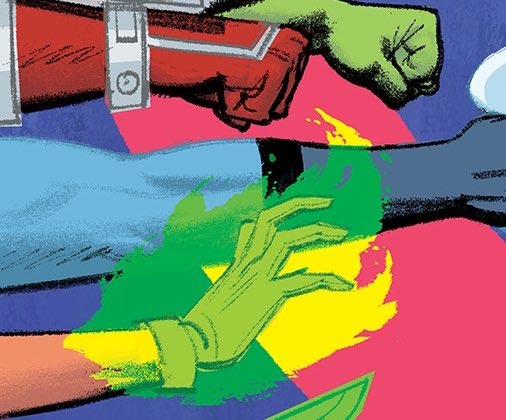
Those arms belong to, from top to bottom, Martian Manhunter, Rocket Red*, Blue Beetle, and Fire. Naturally, this made a lot of people excited at the teased prospect of new comic adventures of the Justice League International.
Of course, that's not what Tom was teasing.
He was baiting the hook with the JLI for a different property he revealed later that same day:
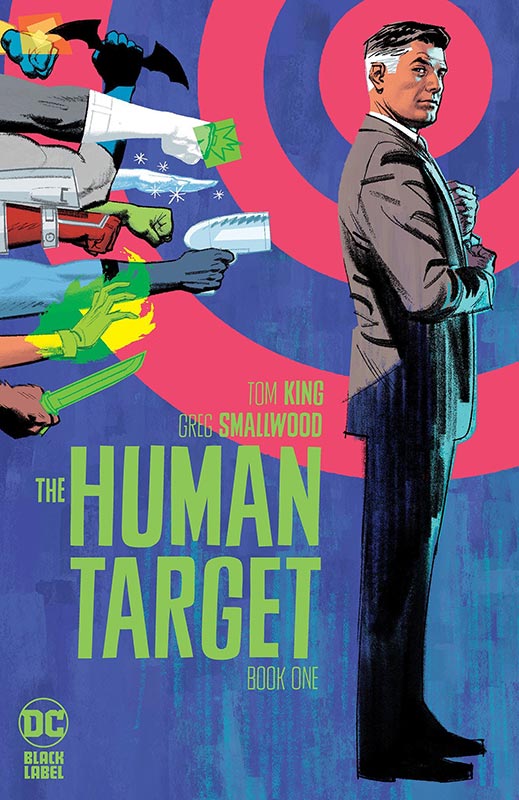
Who can be mad about a bait-and-switch that leads to art this great? (Those new arms belong to Booster Gold, Guy Gardner, Batman, Ice, and G'nort.)
If you didn't know, Christopher "Human Target" Chance has been in the DC Universe since 1972 but is far more famous outside comic books. In addition to recent guest appearances on Arrow, Chance has had his own television series twice (!). Being a TV star probably explains why he and Booster Gold have never crossed paths.
Frankly, the espionage antics of Human Target are a perfect fit for King's storytelling strengths, and any project that keeps King far away from Booster Gold is a project I can support. In fact, I promise to buy a copy of the first issue... but only if they keep that amazing Smallwood cover.
* That Rocket Red arm design belongs to the armor of Maks Chazov, who was never a member of any line-up of any Justice League, international or otherwise. Chazov worked for the pre-New 52 United Nations-sponsored incarnation of Checkmate. But it wouldn't be the JLI without a representative Rocket Red, and all the Reds who appeared on a JLI roster are dead. I guess you can't bring every dead hero back to life.
UPDATE 2021-07-12: Shawn dropped by the comments to point out that Greg Smallwood has posted process and reference pics of the cover's development on Twitter.com. He includes an interior pic of the JLI, and it is glorious.
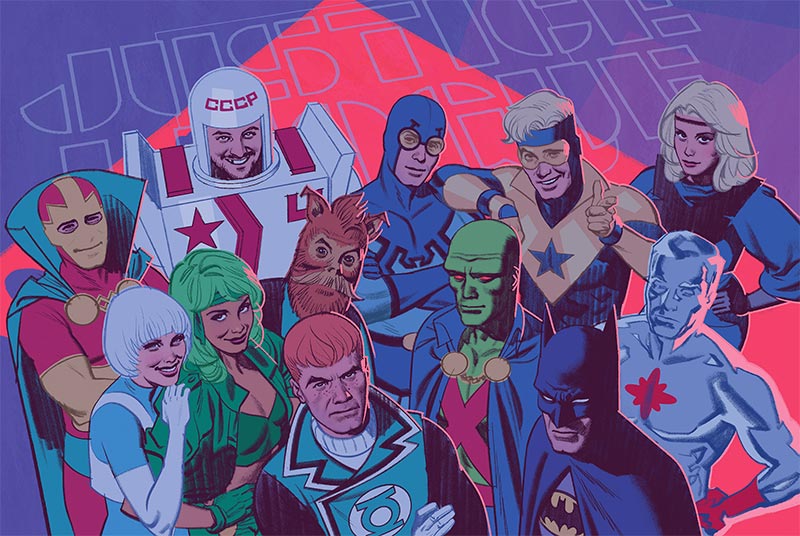
Yep. Definitely buying that.
Comments (6) | Add a Comment | Tags: greg smallwood human target justice league international rocket red tom king twitter.com
Monday, April 19, 2021
Grinding Axes
I try to ignore CBR most of the time. (Are they primarily an entertainment tabloid with a little comic book news or a clickbait farm? Both?) But every once in a while they get my eyeballs, as they did with this article titled "The Justice League's Silliest Member Almost Took Down a Classic Team by Himself" by Nabeel Gaber.
The article is a recap of the events of Justice League #4, which is indubitably the best of the best Booster Gold comics ever. And for the most part, it's actually very positive. But it's not entirely accurate.
I might personally quibble with the description of the Royal Flush Gang as "a classic team" — the "team" is based on a costume gimmick and all the original members are dead, so isn't that a bit like saying that "classic" Gwar is still touring? — but my real complaint comes from this:
It's also significant that Booster Gold and Blue Beetle, two of the goofiest members of the Justice League, were the ones to defeat Ace. Even though these two worked well together in a comedic context, they were also a formidable fighting team.
What Gaber fails to make clear is that Justice League #4 is the *first* team-up between Booster Gold and Blue Beetle. Neither one was ever "goofy" without the other; all the comedy would come later. At the time, this was just powerhouse Booster Gold proving he could work with a team, something that had not been clear in his solo appearances to date.
The "Blue and Gold" paring actually begins in Justice League International #8's "Moving Day," which is the first time the two characters were featured away from the team. (Justice League became Justice League International with issue #7.) The humor developed naturally out of the relationship between the two JLI members who shared the unusual superhero problem of having lost great personal wealth. Comedy is just tragedy plus time.
It's nice that CBR can help modern readers enjoy the great comics of yesteryear. (Justice League #4 came out on May 5, 1987, thirty-four years ago!) But, c'mon. Booster Gold is hardly the Justice League's "silliest" member. Plastic Man is.
Comments (4) | Add a Comment | Tags: blue beetle cbr.com justice league international nabeel gaber
Friday, February 12, 2021
Happy Birthday, Judd Winick
Today Judd Winick is 50 years old, and he has spent many of those years creating comic books. (Technically, he's spent most of the past decade creating best-selling Hilo graphic novels for middle schoolers, but c'mon. We all know graphic novels are just longform comic books.)
Though Winnick has rarely worked on stories involving Booster Gold, there is one notable exception:

Justice League: Generation Lost is the story of former Justice League International members efforts to bring their former mentor, Maxwell Lord, to justice for his subsequent crimes against humanity.
The series began in 2010 and for the most part took into account nearly two decades worth of shared-universe heroic adventures. To Winick's credit, if you'd never read a single issue of Giffen and DeMatteis's Justice League International or Johns' Countdown to Infinite Crisis and Blackest Night, I'm sure you can still enjoy Justice League: Generation Lost. It's as much a traditional superheroic action/adventure story as it is a revenge story.
And for Booster Gold, it was very, very personal.
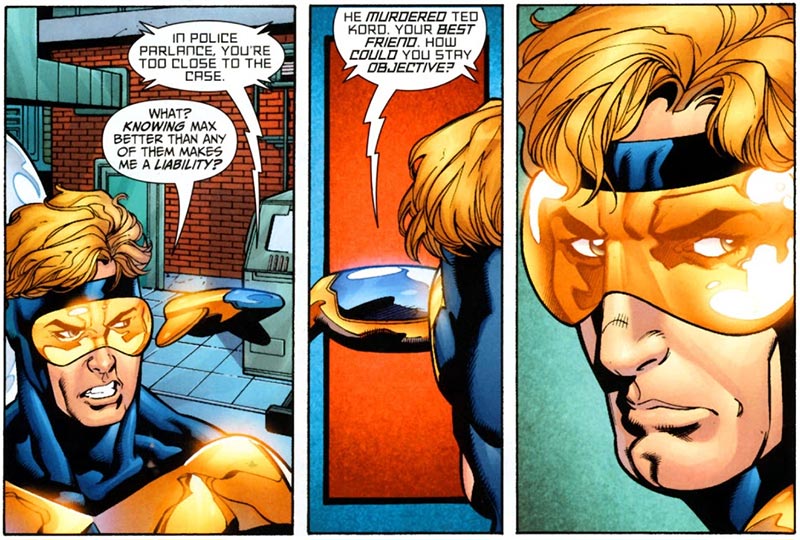
art by Keith Giffen, Aaron Lopresti, Matt Ryan, Hi-Fi, Sal Cipriano
In fact, Booster's key role in this story is a huge part of why I included the series in my 2020 list of the 12 Best Booster Gold stories ever.
Unfortunately, the story's impact was promptly devalued as the established DCU was discarded for the New 52. That means there are a decade's worth of new DC readers who are unlikely to be familiar with this great tale, which is a real shame.
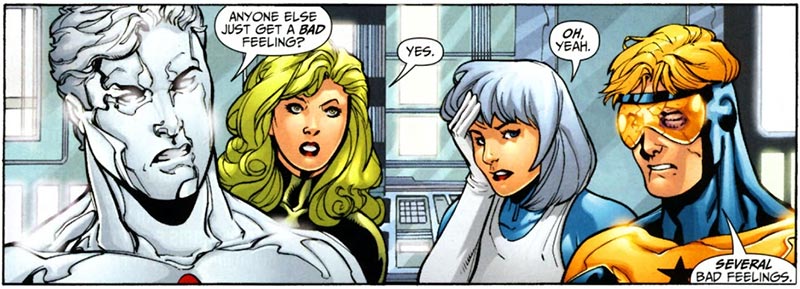
As a birthday present to Mr. Winick, how about re-reading this great series. Better still, recommend it to someone you think would like it. It'll be like Winick gave *them* a present for *his* birthday.
Comments (3) | Add a Comment | Tags: aaron lopresti generation lost judd winick justice league international
Friday, January 1, 2021
Year in Review 2020
Like my favorite super hero, I'm planning to start the year watching my alma mater play football. In the meantime, I present for your nostalgic enjoyment the 5 most-read Boosterrific.com blog posts of 2020, presented in ascending order of hits:
5. Monday, April 6: This Day in History: Without Great Power
In which we revisited Booster Gold's participation in Justice League Europe #50, his first taste of superheroic action after losing his powersuit to Doomsday. Say what you will about his motivations, but Booster Gold's got guts.
4. Friday, March 13: That Time Booster Gold Defeated a Disease
In which we took at look at the events of Booster Gold Volume 1 #17 in light of the pandemic that was sweeping the globe. Conclusion: an impenetrable force field is better than a vaccine.
3. Monday, October 26: The Strong and Silent Type
In which I improved Superman & Batman Magazine #8 by cutting out most panels that don't include Booster Gold. Sorry, I couldn't do anything about that bulky 1990s power suit.
2. Monday, November 9: Two of a Kind: Shattered and Forged
In which we clear up the confusion surrounding DC's announcements of Generations: Shattered and Generations: Future State comic books. Hint: they're the same book. Or, at least we think they are. We'll be more certain when we finally have the book in our hands next week.
1. Friday, December 18: The Best of Booster Gold: Action Comics 995
In which we conclude our year-long series of the 12 best Booster Gold comics. (Maybe those clickbait comic book listicle sites are onto something.)
Let's make 2021 another Boosterrific year!
Comments (0) | Add a Comment | Tags: action comics best of blog justice league europe justice league international lists plague recap superman
SITE SEARCH

SPOILER WARNING: The content at Boosterrific.com may contain story spoilers for DC Comics publications.
Booster Gold, Skeets, and all related titles, characters, images, slogans, logos are trademark ™ and copyright © DC Comics unless otherwise noted and are used without expressed permission. This site is a reference to published information and is intended as a tribute to the artists and storytellers employed by DC Comics, both past and present. (We love you, DC.) Contents of this page and all text herein not reserved as intellectual property of DC Comics is copyright © 2007-2026 BOOSTERRIFIC.com. This page, analysis, commentary, and accompanying statistical data is designed for the private use of individuals and may not be duplicated or reproduced for profit without consent.