




Showing posts 16 - 20 of 24 matching: reviews
Wednesday, October 3, 2012
This Day in History: Meet Bloodspot
Eleven years ago today, DC released JLA: Incarnations, an anthology mini-series focused on telling the "untold" stories set a various points in the prior history of the Justice League. Most of the fun and frustration of this series was in seeing how writer John Ostrander would mangle characterization and history in order to squeeze his new stories into pre-existing continuity. Issue #6, published 11 years ago today, was no exception.
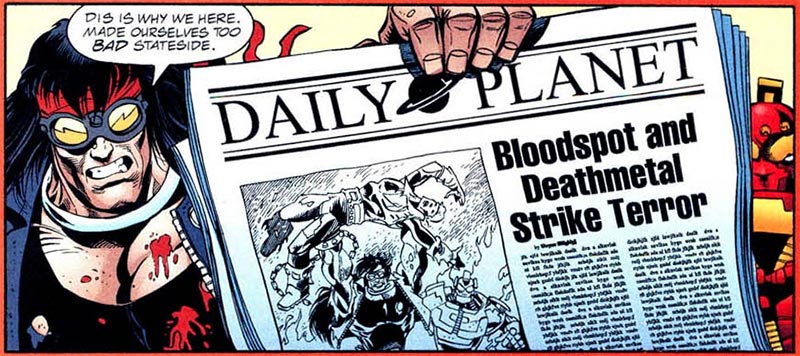
This issue contains two stories set about 7 years apart, and both stories generously feature Booster Gold. Booster and Blue Beetle are the protagonists in the issue's lead story, "Buddies." The pair invent the villainous identities of Bloodspot and Deathmetal in order to sneak into the rogue nation of Bialya. As entertaining as the story is, at times almost everything seems to be an anachronism. Errors stretch from DC Universe chronological impossibilities (Mister Miracle's inclusion in events would have been impossible in the time period) to real-world industry conventions (the ultra-violent "grim and gritty" comics that would feature characters with ridiculous names "Bloodspot" and "Deathmetal" wouldn't be published for several years after the era in which this story was set). Even the relationship between the protagonists is blatantly misrepresented (Booster Gold should be playing straight to Blue Beetle's zany ideas, not the other way around).
The other story, "Authority," doesn't do much better. "Authority" details the untold and much-needed story of the dissolution of Extreme Justice, mostly from the point of view of team leader Captain Atom. Booster naturally plays a part in this story as well, although artist Eric Battle doesn't seem to realize that Booster wore more than one costume between the founding of the Justice League International and the conclusion of the Extreme Justice debacle. Again, Ostrander doesn't let history get in his way, as he, like Geoff Johns in the more recent retcon seen in Justice League International Annual, ignores that the United Nations washed its hands of the JLI long before the end of the team. As we all know, DC's writers never let facts get in the way of telling their stories.
That's not to say these stories aren't enjoyable, because they are. Objectively, they are entertaining reads that add to our knowledge of the period they represent. Subjectively, however, they don't quite live up (or in Extreme Justice's case, down) to the era that inspired them. Without hesitation, I recommend reading the issue, but like any story of historical fiction, I'll leave leave it up to the reader to decide how much truth they contain.
Comments (1) | Add a Comment | Tags: blue beetle history justice league justice league international mister miracle reviews
Wednesday, September 5, 2012
New-ish Release: The Man of Gold
First of all, today's feature isn't exactly a new release; it was published 3 weeks ago. But given that Booster Gold doesn't seem to exist in the DCnU right now, we'll have to take what we can get. Lucky for us, what we can get is a delightful easy reader for second graders that is at least as entertaining as anything DC Comics has published in the DCnU to date.
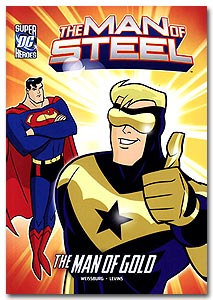

The Man of Gold by Paul Weissburg and accomplished Batman: Gotham Adventures artist Tim Levins is not a comic, but a 5-inch by 7-inch book with illustrations. There's a lot to like in the book's simple, direct prose narrative of how Booster Gold's drive for fame and glory soon threatens both Superman and the safety of the Metropolis itself. While Booster's origin herein may not be exactly what Dan Jurgens wrote, this Booster's personality isn't too far afield from what we saw in his earliest comic book appearances. This Booster is a jerk with a heart of gold.
Booster's primary antagonist in this adventure is the Jack Kirby-created Stompa, a member of Granny Goodness' Female Furies of Apokolips. Despite both characters having decades-long careers in comic books, this is the first encounter between the pair. Their refreshing face-off results in a battle which sees Booster's force field creatively used as an offensive weapon.
Because this book was designed to encourage children to read via the Advanced Reader system in the classroom, it ends with Discussion Questions. Question 3 encourages readers to explain which of the book's 10 illustrations is their favorite. Tim Levin's JLU-inspired art deserves the attention. Detail-oriented readers may spot that Booster wears the collar-less version of his classic power suit in the published book, but Tim Levins' original art online at his Deviant Art page has the more familiar collared powersuit that Booster has worn in all of Justice League Unlimited appearances. The book doesn't have any Discussion Questions encouraging thoughts about the motivation for this change.
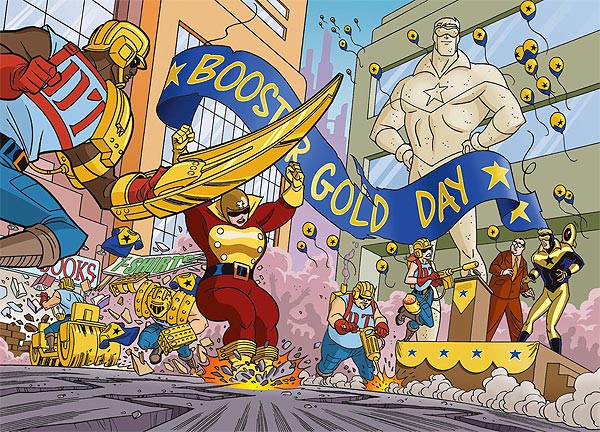
This book is just one in a series of similar books published under the DC Super Heroes license by Capstone Publications (who also re-publish DC Comics with "durable hardcover" bindings for grade school libraries). While your Local Comic Shop may not carry "real" books, you can find a copy of this book at Amazon.com
Comments (4) | Add a Comment | Tags: amazon.com books deviantart.com eyz new releases paul weissburg reviews tim levins

Tuesday, August 7, 2012
Batwing #12: A Critical Response
Last week, Newsarama.com ran "BATWING Goes Global for JLI, Back to Africa for ZERO MONTH," an interview between Vaneta Rogers and Judd Winick. Included in that article was a quote about Winick's hopes for Batwing #12.
Nrama: Fans of your work on Justice League International are looking forward to you writing some of those characters again. How was it for you to return to them in the New 52?
Winick: Oh, it was a blast. I wish it was longer. I had 20 pages to do a lot. I wanted Booster to talk more, you know? So I could write him! I could have done 60 pages on these guys.
But it was really fun to get back to those guys for just a little bit. Just a little bit. I loved doing that entire run. It was fun for me when they announced that Batwing had joined the JLI. I'm sorry to see the book go. But it immediately opened the door for this. I said, "Oh! Can they come play over here? Please?"
I had this idea about this big old fight in Africa, and I thought they could come along. I knew it would be great. And I really enjoyed writing it.
That's what issue #12 is. It's one of those big superhero issues where it actually feels right. You know? You only get to do it now and again where it feels right and makes sense, and doesn't feel like an overload — a whole, big old superhero dogpile. That's what we have for issue #12. It's good fun.
While Winick may have intended Batwing #12 to be a "big old fight," the issue as published feels more like a bait and switch. Yes, Winick sets the scene for a battle royal by establishing bad-blood (and international intrigue!) between the combatants before maneuvering them into their respective corners. But just as the opening bell is rung, the broadcast edits the match for time and cuts straight to the finale. How disappointing!
The issue is all pre-fight and post-fight, with nothing in between. If I only wanted to know who won the fight, I could skip watching the bout and read the headlines in tomorrow's newspaper. Even that would be a waste of time here, since there's never any doubt that the forces of good will ultimately triumph over the forces of evil in mainstream comic books. If we're not paying to see the fight, what are we buying with our $3.00 admission ticket?
To be fair to Winick, he is just part of the team of creative personnel and editors responsible for the finished product. Perhaps penciller Marcus To forgot to include the panels with the real action. Throughout the issue, it's unclear how one panel is supposed to lead to the next; maybe To doesn't understand that sequential art is similar to film making in how it's supposed to tell a story. Or maybe issue editor Harvey Richards decided that showing the widespread combat this issue was theoretically centered around would be too graphic for the desired teen audience. This wouldn't be the first issue of the New 52 that DC Editorial had damaged its published product with enigmatic decision-making.
Whatever the reason, this issue ultimately feels like 5-10 pages were left on the cutting room floor. Winick did deliver big in the 26-issue Justice League: Generation Lost, where he had plenty of space to develop his story into a semi-satisfying finale (that thanks to DC's post-Flashpoint market strategy will never have its necessary follow-up). This begs the question of whether it is even possible to deliver an epic plot in the modern 20-page comic book that promotes digitally-aided pin-up art over old-fashioned plot narrative. If Batwing #12 is any indication, the answer is "no."
Comments (3) | Add a Comment | Tags: batwing judd winick newsarama.com reviews vaneta rogers
Wednesday, April 18, 2012
This Day in History: Booster Gold Strikes Out
As most fans know by now, DC Comics has just canceled Hawk and Dove again. The pair has a terrible track record at maintaining a series, in no small part due to the fact that they have never had a first-tier writer. Their stories tend to be hackneyed and dull, typically accompanied by lackluster art.
DC was no doubt acutely aware of the pair's limitations when they launched the third Hawk and Dove series in 1989. To ensure a good launch, the series included several higher profile guest stars in an extended Invasion! flashback. Naturally, this flashback was designed to make Hawk and Dove -- and not their guest stars -- look good.
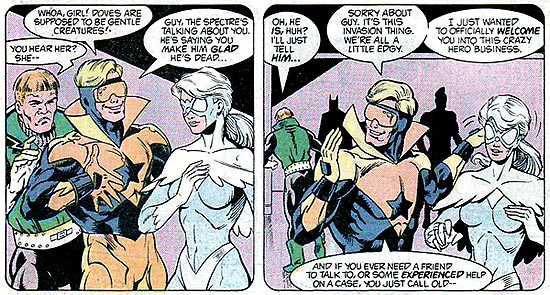
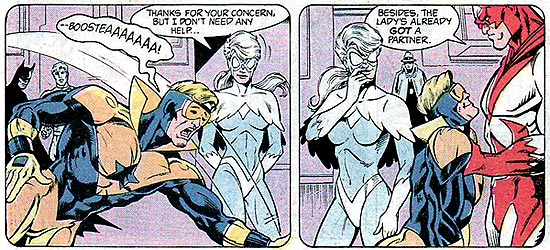
Always smooth with the ladies, Booster. (At least Firestorm couldn't have done any better, right Shag?) Two years earlier, Booster had saved Hawk's life in the Mexican desert in Booster Gold #17. Booster was quite rude at the time, though Hawk had been unwittingly assisting in a madman's genocidal plot. Perhaps catching a falling Booster is Hawk's way of returning the favor.
Outside the character pieces presented in the flashbacks, the rest of the book is really quite dull. Hawk and Dove pal around with some friends that are not introduced to the reader, then the heroes make a mess of stopping a run-of-the-mill supervillain who is naturally using his advanced, lifelike robots to rob jewelry stores. This issue is costumed comic books at their most droll, a time-capsule of late-1980s mainstream storytelling given a golden lining with the inclusion of Booster Gold.
Perhaps this very lack of a signature adventuring style is the reason that the pair have had so much trouble maintaining their own series over the years. Maybe they need a home in a more forgiving ensemble environment. I hear the JLI is hiring.
Comments (2) | Add a Comment | Tags: hawk and dove history reviews
Friday, March 30, 2012
This Day in History: the End
DC Co-Publisher Dan Didio has called it "probably my favorite comic of all things published in the last ten years." Comic book blogger Robby Reed has called it "staggeringly awful." Your response probably lies somewhere in between, depending on how much you care for DC continuity or the Blue Beetle.
This divisive comic book is Countdown to Infinite Crisis #1. Released 7 years ago today, this one-shot issue, officially titled DC Countdown in the legal indicia, kicked off the 4 separate mini-series leading to Infinite Crisis. It is more famous for re-introducing Justice League International supporting-character Maxwell Lord as a villain. And, of course, the related fate of Ted Kord.

While I still find this book to be an enjoyable read, I also believe that DC was short-sighted in choosing Ted Kord to be the sacrificial lamb to promote high sales of the Infinite Crisis crossover. The friendship of Booster Gold and Blue Beetle was unique in the DC pantheon: genuine but irreverent, lighthearted but sincere. Even when their misadventures strained plausibility, it was always worth going along for the ride just to bask in the reflected glow of their effervescent joy at being together. Simply put, their adventures were fun.
Booster Gold has enjoyed a career renaissance since the death of his best friend and business partner. However, the DC Universe is a smaller place without Ted Kord, and we have DC Countdown to Infinite Crisis to thank for it.
Comments (0) | Add a Comment | Tags: blue beetle comicbookresources.com countdown to infinite crisis dan didio dialbforblog.com history reviews robbie reed
SITE SEARCH

SPOILER WARNING: The content at Boosterrific.com may contain story spoilers for DC Comics publications.
Booster Gold, Skeets, and all related titles, characters, images, slogans, logos are trademark ™ and copyright © DC Comics unless otherwise noted and are used without expressed permission. This site is a reference to published information and is intended as a tribute to the artists and storytellers employed by DC Comics, both past and present. (We love you, DC.) Contents of this page and all text herein not reserved as intellectual property of DC Comics is copyright © 2007-2026 BOOSTERRIFIC.com. This page, analysis, commentary, and accompanying statistical data is designed for the private use of individuals and may not be duplicated or reproduced for profit without consent.